
Disclosure: Some links on this page are affiliate links. We may earn a commission if you make a purchase through them, at no additional cost to you.
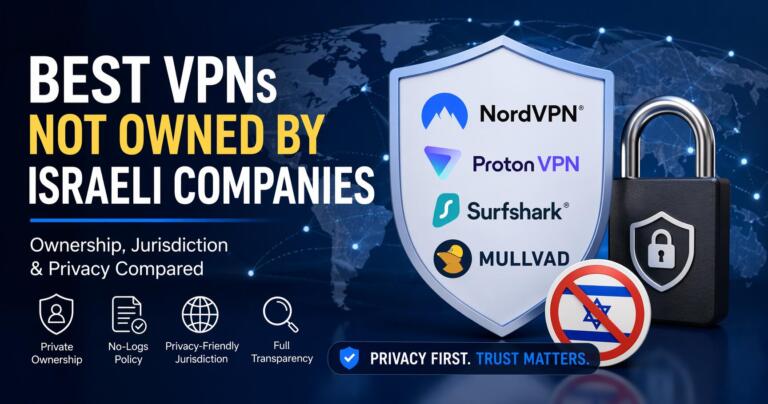
Quick answer: If you specifically want a VPN that is not owned by an Israeli company, the strongest mainstream options are NordVPN, ProtonVPN, Surfshark, and Mullvad. Each has a clearly documented non-Israeli ownership structure, but ownership alone is not enough — you should also look at jurisdiction, logging practices, audits, and how transparent the company is about who controls the service.
Most VPN buyers focus on speed tests, streaming access, and discounts. But for a more privacy-focused reader, one of the first questions is often much simpler: who actually owns the VPN company? That question matters because ownership affects trust, corporate accountability, legal exposure, and how seriously you should take a provider’s privacy promises.
If you are specifically looking for a VPN not owned by an Israeli company, you are really asking for something bigger than a country filter. You are asking for ownership clarity, clean corporate structure, and enough transparency that you know who is behind the service you are routing your traffic through.
This guide takes that concern seriously. Instead of turning the topic into politics, it looks at the issue the right way: ownership, parent companies, legal base, transparency, and real privacy value. The strongest options for most users are NordVPN, Proton VPN, Surfshark, and Mullvad.
Why people search for VPN ownership
Privacy concerns and trust signals
People do not usually search for VPN ownership because they are interested in corporate trivia. They search because a VPN is not a normal app. It sits between you and the open internet. It sees your connection requests, your IP movement, and the network path your traffic takes. That is why ownership becomes a trust signal.
For some users, this is mostly about transparency. For others, it is about legal risk, company culture, or whether the brand has a history of vague disclosures. Whatever the reason, the core question is fair: if a VPN is asking you to trust its no-logs claim, you should know who runs it.
Jurisdiction vs ownership – what users actually mean
A lot of people searching this topic are not only asking “who owns the VPN?” They are also asking “which country’s laws apply to this company?” Those are different questions. A VPN can have one brand name, one operating company, and one parent company, all tied to different places. That is why ownership and jurisdiction need to be analyzed together.
Common misconceptions about VPN ownership
The biggest mistake people make is assuming the public brand name tells the full story. It usually does not. Some VPNs belong to larger cybersecurity groups. Some operate through separate legal entities. Some disclose this clearly, while others bury it in support pages or legal text. A good ownership analysis looks beyond the homepage.
How VPN ownership actually works
Brand vs operating company vs parent company
When you see a VPN brand in an ad, that is only the consumer-facing layer. Underneath that, there is usually an operating company handling contracts, billing, app distribution, or service delivery. Above that, there may be a parent company controlling multiple security products. If you want the full picture, you need all three layers.
Why parent companies matter more than brand names
Parent companies matter because they control the wider direction of the product. They shape budgets, legal policy, acquisitions, and strategic priorities. If two VPN brands look separate on the surface but belong to the same parent company, that changes how you should think about market independence and ownership diversity.
How mergers and acquisitions affect VPN ownership
The VPN industry is no longer a collection of tiny standalone products. It has matured, and that means mergers, holding structures, and cybersecurity groups. This matters because a VPN that was once independent may no longer be independent. Anyone writing about VPN ownership has to account for these changes instead of repeating outdated assumptions.
Why transparency varies across providers
Some VPN providers treat transparency as part of the product. Others treat it as an afterthought. The best providers make it easy to identify the legal entity, jurisdiction, and ownership model. The weaker ones rely more on slogans than specifics. That gap in disclosure is often more revealing than the marketing itself.
Best VPNs not owned by Israeli companies
NordVPN – ownership, structure, and jurisdiction
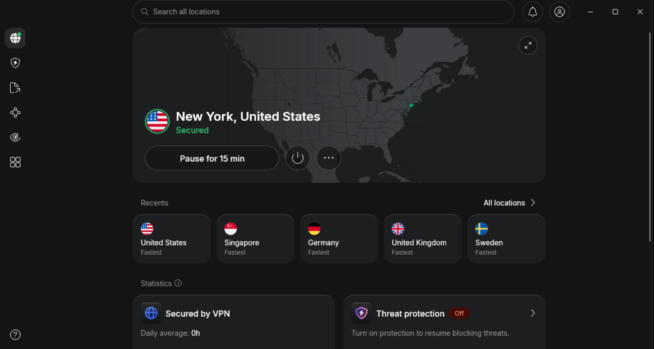
Who owns it: NordVPN says the service is owned and operated by nordvpn S.A., while its support material also states that Nord Security is the parent company and that Nord Security is based in the Netherlands. Nord’s founder page says NordVPN was created by Tom Okman and Eimantas Sabaliauskas. For a reader focused on ownership, the practical answer is that NordVPN sits inside the broader Nord Security group. Read more information on who owns NordVPN.
Why that matters: This makes NordVPN a large European cybersecurity-backed service rather than a thin standalone VPN brand. That can be a positive if you want a well-resourced company with mature infrastructure, but it also means you should evaluate the wider group, not just the app icon on your phone.
Jurisdiction and structure: NordVPN states that the VPN service operates under Panama’s jurisdiction. That is important because Panama is often cited as a privacy-friendlier legal environment for VPN operations. At the same time, Nord Security as parent company is based in the Netherlands, which is relevant for understanding the broader corporate structure.
Bottom line on ownership: NordVPN is not owned by an Israeli company. It belongs to a European cybersecurity group with a Panama-based VPN operating structure, which is one reason it remains one of the strongest all-round recommendations for users who care about both performance and ownership transparency.
Proton VPN – ownership, foundation model, and transparency
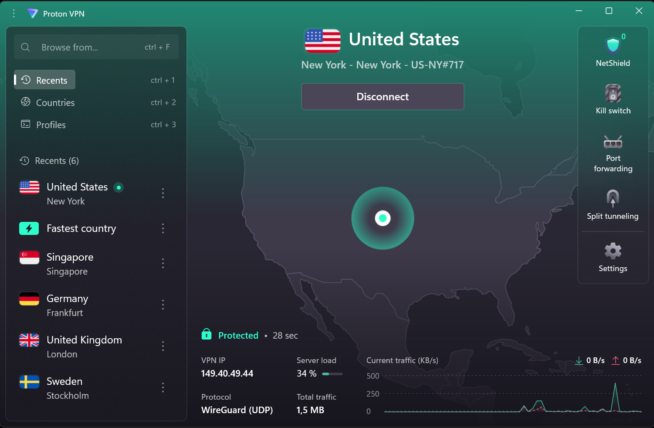
Who owns it: Proton says Proton VPN is a service provided by Proton AG, a company based in Switzerland. Proton also states that the primary shareholder of Proton AG is the Proton Foundation, a Swiss nonprofit structure designed to keep the company aligned with the interests of the Proton community over the long term. Read more information on who owns Proton VPN.
Why that matters: This is one of the clearest and most credibility-enhancing ownership models in the VPN space. Instead of a vague holding structure or a hard-to-trace corporate shell, Proton publishes a straightforward explanation of who operates the service and who ultimately controls it.
Jurisdiction and structure: Proton’s Swiss base is a major part of its privacy narrative. The company pairs that with a foundation-backed governance model, which is unusual in the VPN market and attractive to users who do not want a purely growth-at-all-costs ownership setup.
Bottom line on ownership: Proton VPN is not Israeli-owned. It is Swiss-operated, foundation-backed, and unusually transparent about who controls the company. If ownership clarity is a top criterion, Proton VPN is one of the easiest services to justify.
Surfshark – ownership, merger with Nord Security, and implications
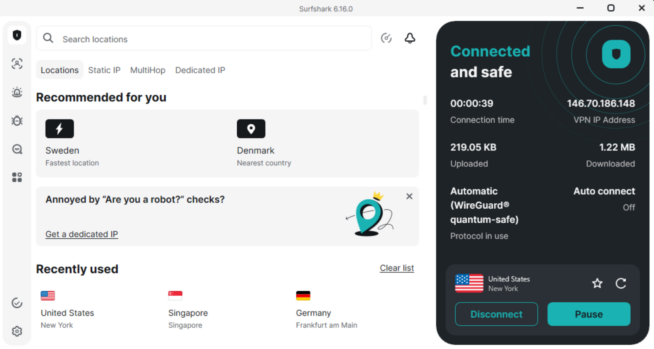
Who owns it: Surfshark says its founder is Vytautas Kaziukonis and that in 2022 Surfshark and Nord Security merged under one holding company while continuing to operate independently. Surfshark also states that the company is based in the Netherlands.
Why that matters: Surfshark is a good example of why you cannot stop at the brand name. On the surface, it looks like a separate VPN competitor to NordVPN. At the ownership level, though, it sits under the same wider corporate umbrella. That does not make it a bad recommendation, but it does mean ownership concentration is real in the VPN market.
Jurisdiction and structure: Surfshark presents itself as Netherlands-based, with the merged holding relationship to Nord Security forming the key corporate context. For users filtering out Israeli ownership, Surfshark clearly qualifies. For users trying to maximize ownership diversity, the Nord Security connection is the important detail.
Bottom line on ownership: Surfshark is not owned by an Israeli company, but it is not a fully standalone VPN either. It is part of the same larger structure as NordVPN, which makes it a strong value option but not a separate ownership universe.
Mullvad – independent ownership and privacy-first model

Who owns it: Mullvad states that Mullvad VPN AB is owned by parent company Amagicom AB, and that Mullvad VPN AB and Amagicom AB are 100% owned by founders Fredrik Strömberg and Daniel Berntsson, who are actively involved in the company.
Why that matters: This is the most straightforward ownership story on the list. There is no giant cross-brand holding structure to decode. There is no complicated consumer brand versus mystery parent-company problem. Mullvad makes it very clear who owns the company.
Jurisdiction and structure: Mullvad is Swedish, privately controlled by its founders, and known for a privacy-first operating philosophy. That matters because ownership transparency is strongest when the company is willing to say exactly who holds the shares and who runs the business.
Bottom line on ownership: Mullvad is not Israeli-owned. It is one of the clearest examples of direct founder ownership in the VPN market and one of the easiest services to recommend to users who want the least ambiguous ownership model possible.
VPN ownership comparison table
Full breakdown of ownership, jurisdiction, and parent companies
| VPN | Who owns it | Parent company / structure | Stated base / jurisdiction | Ownership takeaway |
|---|---|---|---|---|
| NordVPN | nordvpn S.A. / Nord Security group | Parent company: Nord Security | VPN under Panama jurisdiction; parent based in the Netherlands | Not Israeli-owned; large European cybersecurity group |
| Proton VPN | Proton AG | Primary shareholder: Proton Foundation | Switzerland | Not Israeli-owned; strong transparency and foundation model |
| Surfshark | Surfshark brand under merged holding with Nord Security | Same holding structure as Nord Security | Netherlands | Not Israeli-owned; shared parent context with NordVPN |
| Mullvad | Mullvad VPN AB | Parent: Amagicom AB, owned by founders | Sweden | Not Israeli-owned; clear founder ownership |
What matters more than ownership alone
Jurisdiction and legal environment
Ownership matters, but legal jurisdiction often matters just as much. A provider can have a non-Israeli ownership structure and still operate under laws that are less attractive for privacy. That is why Panama, Switzerland, and similar jurisdictions show up frequently in privacy discussions.
No-logs policy and audits
If a VPN claims not to log meaningful user activity, that claim should ideally be backed by audits or other verifiable trust signals. A clean ownership structure is useful, but it does not replace technical and legal evidence that the company minimizes retained data.
Technical security
Strong protocols and sound app design matter more than branding language. If you want to understand the technical side better, see our guides on WireGuard, OpenVPN, and IKEv2.
Transparency reports and real-world trust
The best providers do not just tell you to trust them. They publish company information, legal structure, policy explanations, and practical details that make it easier to verify their claims. Transparency is often the best sign that the company expects scrutiny and is prepared for it.
Red flags to watch for
If a VPN makes bold privacy promises but gives you no clear company identity, that is a warning sign. Other red flags include vague legal pages, missing jurisdiction details, and aggressive marketing that avoids corporate specifics.
Why some VPNs hide their structure
Sometimes it is just sloppy disclosure. Other times it is because the company knows that once users trace the ownership chain, the privacy story becomes less impressive. Either way, opacity is not what you want in a product that asks for network trust.
Risks of choosing opaque providers
A VPN with murky ownership might still work for streaming, but that is not the same as being a trustworthy privacy product. If you cannot identify the operator, you cannot properly assess legal exposure, accountability, or whether the company deserves your confidence.
How to verify VPN ownership yourself
Where to find official ownership information
Start with the provider’s About, Terms, Privacy Policy, Help Center, and support pages. Many ownership details are hidden in these sections rather than on landing pages.
How to identify parent companies
Look for language like “parent company,” “holding company,” “primary shareholder,” or “operated by.” Those phrases are often more revealing than the homepage branding.
How to cross-check claims with audits and reports
Once you have the company name, compare it against public audits, transparency materials, and the provider’s own legal disclosures. That will tell you whether the ownership narrative is consistent or just selective marketing.
- Identify the legal operating entity.
- Identify the parent company or controlling shareholder.
- Confirm the stated jurisdiction.
- Check whether the provider explains logs and audits clearly.
- Compare those claims against the company’s broader trust reputation.
Who should care about VPN ownership?
Privacy-focused users
If privacy is your primary reason for using a VPN, ownership should absolutely matter to you. It is not the only criterion, but it belongs near the top of the list.
Journalists and activists
Users in higher-risk environments usually need more than good speeds and working apps. They need a provider with a trust model that survives scrutiny, and ownership is part of that.
Everyday users – does it really matter?
Even for normal users, it still matters. You may not need the most privacy-maximalist provider on the planet, but you should still prefer a VPN that is transparent about who runs it rather than one that hides behind vague language.
Pros and cons of focusing on ownership
Pros of choosing based on ownership
Why ownership screening helps
- Filters out providers with weak transparency
- Helps you understand who controls the product
- Makes legal and jurisdiction analysis easier
- Improves trust decisions for privacy-focused use
Where ownership screening falls short
- Ownership alone does not prove privacy quality
- A good jurisdiction can still coexist with weak practices
- Shared parents reduce diversity across brands
- Technical audits still matter just as much
Final recommendation
If you want the safest all-round mainstream pick, NordVPN is the easiest recommendation because it combines ownership clarity, scale, usability, and a privacy-friendly VPN jurisdiction. If your priority is the cleanest trust narrative and strongest transparency posture, Proton VPN is one of the best fits. If you want low cost and strong feature value, Surfshark remains attractive, though you should understand its Nord Security relationship. If you want the simplest ownership story and a very privacy-native ethos, Mullvad is the cleanest choice of all.
Need a privacy-focused VPN with transparent ownership?
Choose a provider that does more than market privacy. Choose one that explains who owns it, where it operates, and how it protects users in practice.
FAQ – VPN ownership and privacy
Is NordVPN owned by an Israeli company?
No. NordVPN says the service operates under Panama jurisdiction and that its parent company, Nord Security, is based in the Netherlands.
Is Surfshark Israeli-owned?
No. Surfshark says it is based in the Netherlands and that it merged with Nord Security under one holding company while continuing to operate independently.
Does VPN ownership matter for privacy?
Yes, but it is not the only factor. Ownership should be considered together with jurisdiction, no-logs policy, audits, and technical security.
Which VPN has the most transparent ownership?
Proton VPN and Mullvad are especially strong here because both explain their ownership models clearly and do not rely on vague branding language.
How can I check who owns a VPN?
Check the provider’s About pages, support pages, privacy policy, terms, and company disclosures. Look specifically for the legal operating entity, parent company, and stated jurisdiction.
Which option is best if I want the clearest founder ownership?
Mullvad is the cleanest example in this list because the company openly states that Mullvad VPN AB and its parent company are fully owned by its founders.